Trading Meme Coins With a Tiny $10 Portfolio
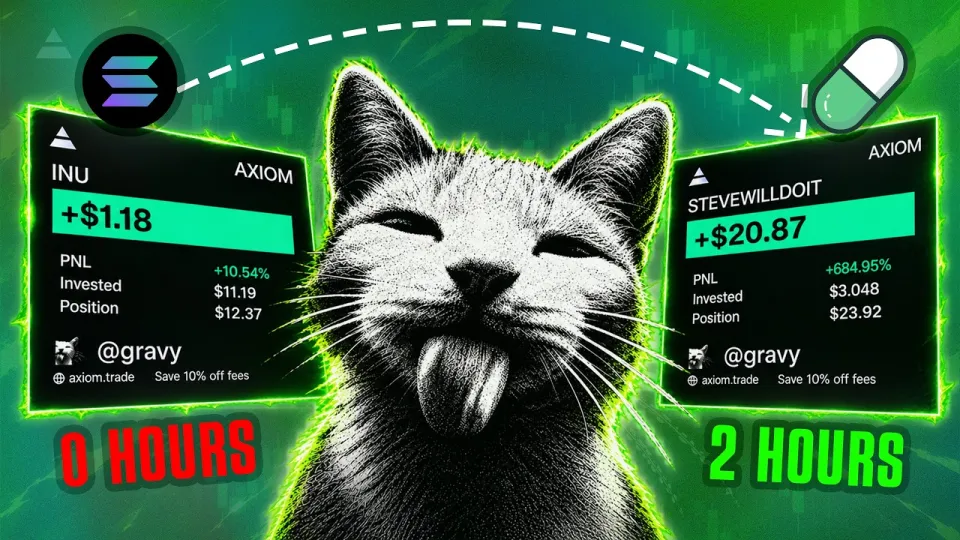
Video: I Tried Trading Memecoins with Just $10
You can order the same kind of articles for your own video to boost it on YouTube and Google. Just message the Telegram bot @sat_sit_bot. The bot writes and publishes the articles itself (with your YouTube video embedded) on popular topical websites (no ads). Your first 50 articles are free.
Meme coin trading with a tiny balance is possible, but only if you treat fees and exits as the main variable rather than an afterthought. In a $10 experiment on Solana, five buys capped at 0.05 SOL each were enough to show that narrative timing and selling discipline decide the result far more than the entry price. The trades were placed through Axiom, the terminal used for the whole run.
The test came from the channel gravy, which walked through every position — why it was bought, why it was sold, and which one was mishandled. The point was never to turn $10 into a fortune; it was to check whether a small portfolio survives the friction that supposedly eats small accounts alive.
What $10 actually buys in meme coins
A $10 bankroll on Solana is a position-sizing exercise before it is a trading one. At typical SOL prices, 0.05 SOL is a few dollars, which means each trade risks a meaningful slice of the account and every fee is visible in percentage terms.
Three costs hit a small meme coin trade at once:
- Network fee — paid in SOL per transaction, small in absolute terms but large relative to a $2–3 position.
- Platform or aggregator fee — the terminal or router takes a cut on entry and often on exit.
- Slippage and price impact — thin liquidity on a fresh launch means your fill is worse than the chart price you clicked.
With $10, a round trip that costs a few percent in fees and slippage needs a real move just to break even. That is the honest argument against small-balance meme coin trading, and it is the argument the experiment was designed to test rather than dismiss.
The five trades and what each one taught
The experiment covered five tickers, and each one stands for a different lesson about narrative trading. None of the buys went over 0.05 SOL, so the sample is consistent even if the outcomes were not.
- STEVEWILLDOIT — a pure narrative play built on a recognizable internet character. The lesson: when the story is the product, the exit is decided by attention, not by any metric.
- NPC — a coin riding a meme format the timeline already understood. Familiar formats spread fast and die fast, so the sell plan matters more than the buy.
- MET (Meteora) — a ticker tied to a real protocol name, which changes the risk profile because traders can compare it to something concrete.
- PUMPY the Trader — a character-driven launch in the pump.fun style, where the earliest buyers set the tone for everyone after them.
- UNTXD — the trade that was fumbled. The thesis was there; the execution was not, and the lesson is that a good idea sold badly is still a loss.
The X Money coin meta that ran alongside these trades was driven by e/acc and Cream narratives — cultural signaling rather than product news. That is the pattern to internalize: meme coin metas are usually about who is talking and why, not about what is being built.
Why narrative timing beats chart reading
On meme coins, the narrative is the fundamental, and timing the narrative is the whole job. A coin with a story the timeline already repeats will outperform a technically cleaner chart with no story, because there is no earnings report or roadmap to anchor price — only attention.
The practical sequence for a small account looks like this:
- Identify the meta of the week — which character, protocol reference or joke format is currently circulating.
- Check whether the coin is early in that meta or late; late entries pay for early exits.
- Size the position so a total loss does not end the session — with $10, that means fractions of SOL, not whole ones.
- Set the exit before buying: a fixed target, a trailing rule, or a time limit.
- Accept that most attempts fail and that the winners must be large enough to cover the losers plus fees.
The hardest part, as many small traders point out, is that by the time a narrative looks obvious, the move has often already happened. Buying a dip in a dying meta is not the same as buying a dip in a live one, and telling them apart is the actual skill.
Fees, referrals and the real cost of small trades
Fee structure decides whether a small portfolio is viable at all. A terminal that returns part of the fee changes the math on every trade, which is why referral programs matter disproportionately when positions are $2–3 rather than $200.
The Axiom referral used in the experiment advertises doubled cashback and a 15% reduction in fees, and those terms are the difference between a strategy that bleeds and one that can compound slowly. On a $10 account, a percentage point of fee is a percentage point of the entire bankroll.
Beyond fees, three habits keep small accounts alive:
- Batch decisions, not impulses. Decide the exit when you enter; do not renegotiate with yourself while the chart moves.
- Track the total, not the trade. A single win feels good; only the running total tells you whether the approach works.
- Keep a cash buffer in SOL. Fees are paid in SOL, and an account with zero SOL cannot exit a position even if it is in profit.
Common questions from small-balance traders
Small accounts generate the same doubts again and again, and most of them come down to process rather than luck. The most frequent one is how anyone keeps up with narratives at all — the volume of posts, the shifting cast of influential accounts and the speed of rotation make it feel like a full-time job.
The honest answer is that nobody tracks everything. Successful narrative traders follow a narrow slice of the timeline, keep a short list of formats that historically spread, and accept missing most opportunities. The second recurring doubt is about selling: traders report cutting a position after a 20–40% drawdown, only to watch it run higher later. That is usually a sizing problem, not a prediction problem — a position small enough to hold through noise removes the pressure to sell at the worst moment.
A third theme is consistency. Finding one good narrative is luck; finding them repeatedly comes from the same routine of scanning, sizing and exiting on rules. And a fourth is the question of whether any of this is worth it below a certain balance — a question the $10 experiment answers with a qualified yes, provided fees are minimized and expectations are set at learning rather than earning.
Useful links
- Axiom trading terminal and referral: https://axiom.trade/@gravy
- The Trenches Discord: https://discord.gg/W7TqkExcSd
- Discord with free Axiom imports and trade signals (NFA): https://discord.gg/9W5j3XUgYB
- gravy on X: https://x.com/gravyski
- Leverage trading with 20% futures fee reduction: https://www.bitbase.com/landing-page/trading-earning-Gra?ref=8CYOGY
Bottom line
A $10 meme coin portfolio is a lab, not an income. The five trades show that small positions can be executed cleanly on Solana, that narrative timing is the only edge available at this size, and that fees and exits decide the outcome more than the entry ever does. The fumbled trade is the most useful part of the run: it proves that execution errors cost real money even when the idea is right. gravy's walkthrough is worth watching for the reasoning behind each buy and sell rather than for the profit numbers. If you want to replicate the setup, start through the Axiom referral link and keep every position small enough that a full loss is survivable.
Key takeaways
- Five real meme coin trades, each buy kept under 0.05 SOL — roughly a few dollars at Solana prices.
- Tickers covered: STEVEWILLDOIT, NPC, MET (Meteora), PUMPY the Trader and UNTXD.
- The X Money coin meta ran on e/acc and Cream narratives, not on fundamentals.
- Fees and slippage matter more than conviction when the position size is this small.
- One of the five trades was badly fumbled — execution, not the thesis, was the problem.
Source: I Tried Trading Memecoins with Just $10 · Markdown version
Questions & answers
Can you really trade meme coins with only $10?
Yes, technically — the experiment placed five buys on Solana with none above 0.05 SOL. But fees, slippage and platform cuts take a larger share of a tiny position, so the realistic goal is learning execution rather than building meaningful profit.
How do you find meme coins with a good narrative before they run?
There is no way to track every post and influencer. Most consistent traders follow a narrow slice of the timeline, keep a short list of formats that historically spread, and accept that they will miss most opportunities. Being early in a live meta matters more than finding every meta.
Why do small traders sell at a 20–40% loss and then watch the coin recover?
Usually because the position is too large relative to the account, so normal volatility feels like a crisis. Sizing each trade so a full loss is survivable removes the pressure to sell at the worst moment and lets a defined exit rule do the work.
Do referral programs and fee discounts matter with such a small balance?
They matter more than with a large account. When a position is a few dollars, a percentage point of fee is a percentage point of the whole bankroll, so cashback and reduced fees directly change whether a strategy can compound at all.